
Selling Practical Effects: TOTAL RECALL gets a facelift
or, how to give your character - but not your audience - a splitting headache
Total Recall has a lot of fun with faces, prosthetics, and puppets.
In addition to the physical elements, how they’re used by the actors, and how they’re filmed, it’s also the shots around the ‘money shots’ which help sell these special effects!
We’re examining how these two scenes use similar techniques to deliver their central, clever special effects: here, we look at Total Recall’s most famous prosthetic of a less-famous face; next, we look at a less-famous prosthetic of one of the world’s most-famous faces.
The Scene
Setup
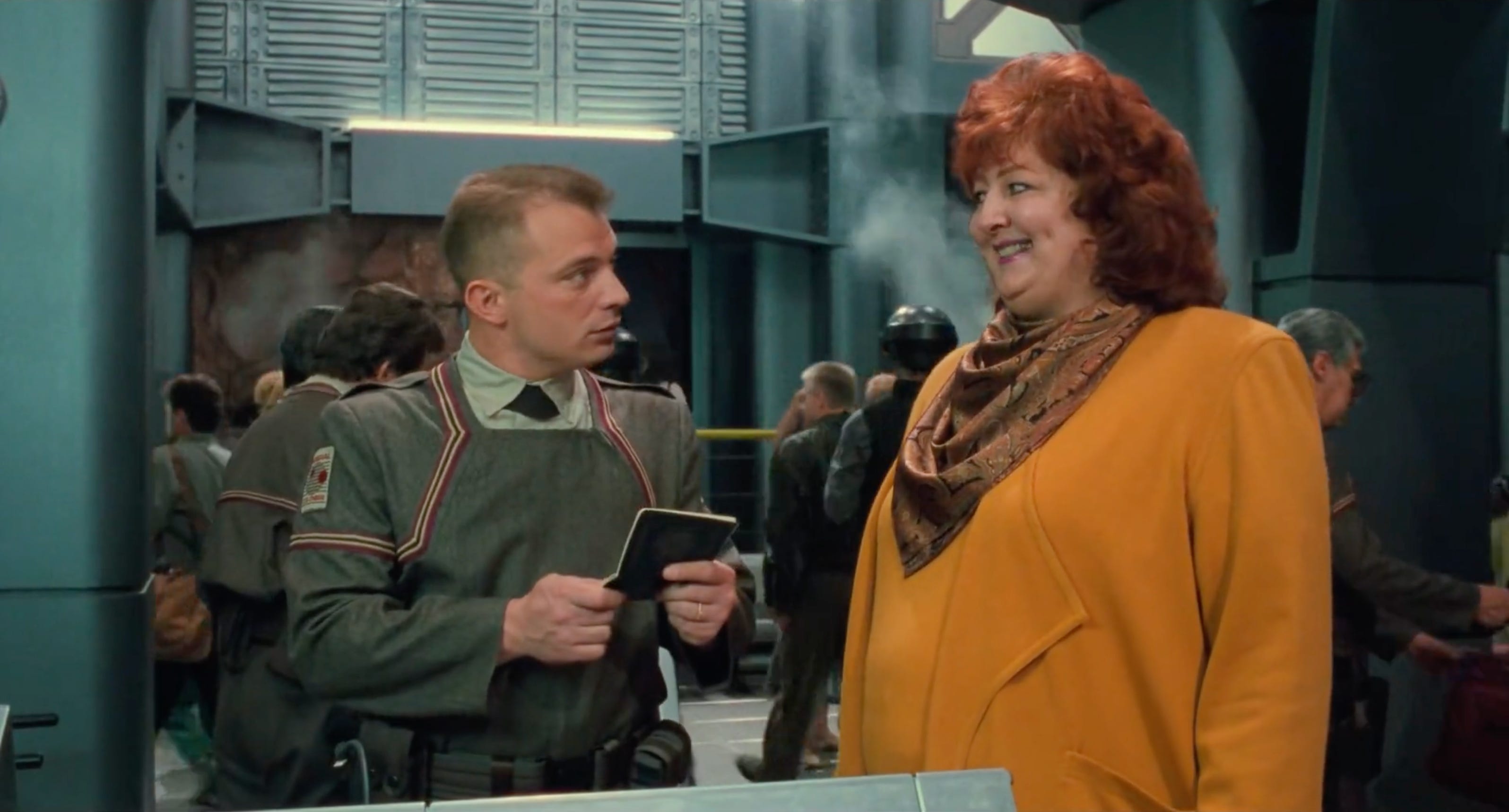
The scene establishes “Quaid-disguised-as-a-woman” (played by Priscilla Allen, credited as "Fat Lady") by having the camera pan with Richter (Michael Ironside) and his baddies as they walk past her.
Fat Lady’s yellow coat, patterned silk scarf, and red hair, all make her stand out amongst the blues and greys; as the baddies pass, and their words trail off and are mixed down, the border agent begins speaking to her.
She stands out, and we are drawn to her by motion, audio, and color.
Many Angles, Many Cuts
Number of Shots
The number of edits from Fat Lady’s introduction til Quaid hits the deck is 42 (with one ‘hidden’ by the fireball explosion).
I’m not about to argue “you need X number of cuts per second” for a scene to be dynamic. But why do they have forty-two cuts in just under two minutes?
It’s not the number in and of itself; Verhoeven uses speed combined with the variety of shots, and the fact none are ‘just for the hell of it.’
Variety of Shots
Wides to mediums to closeups; shorter shots (eg. the passport stamp, the “Quaid!” reaction shot, and the fireball) mixed in with longer shots; some moving and some still; some where people or objects are moving, and a few where people or objects are still and giving facial expressions; some from high angles and some from slightly lower angles and many from approximately eye-level.


Not For the Hell of It
All these shots either tell us something — how passerby are reacting, where Richter is and what he is doing, what in space the Fat Lady’s face is doing now — and/or intentionally ‘break up’ the shots of the mechanical head to better enable its use.
Speaking of that head . . .
Getting The Most from Your Head
The Head Itself
There’s a reason this is one of the most iconic shots in cinema — Rob Bottin and team built a masterpiece.
Of course, they actually built several; not only dozens of trials and errors, but they needed four different heads for the gags — regular replica, the ear extender, the separator, and the bomb.
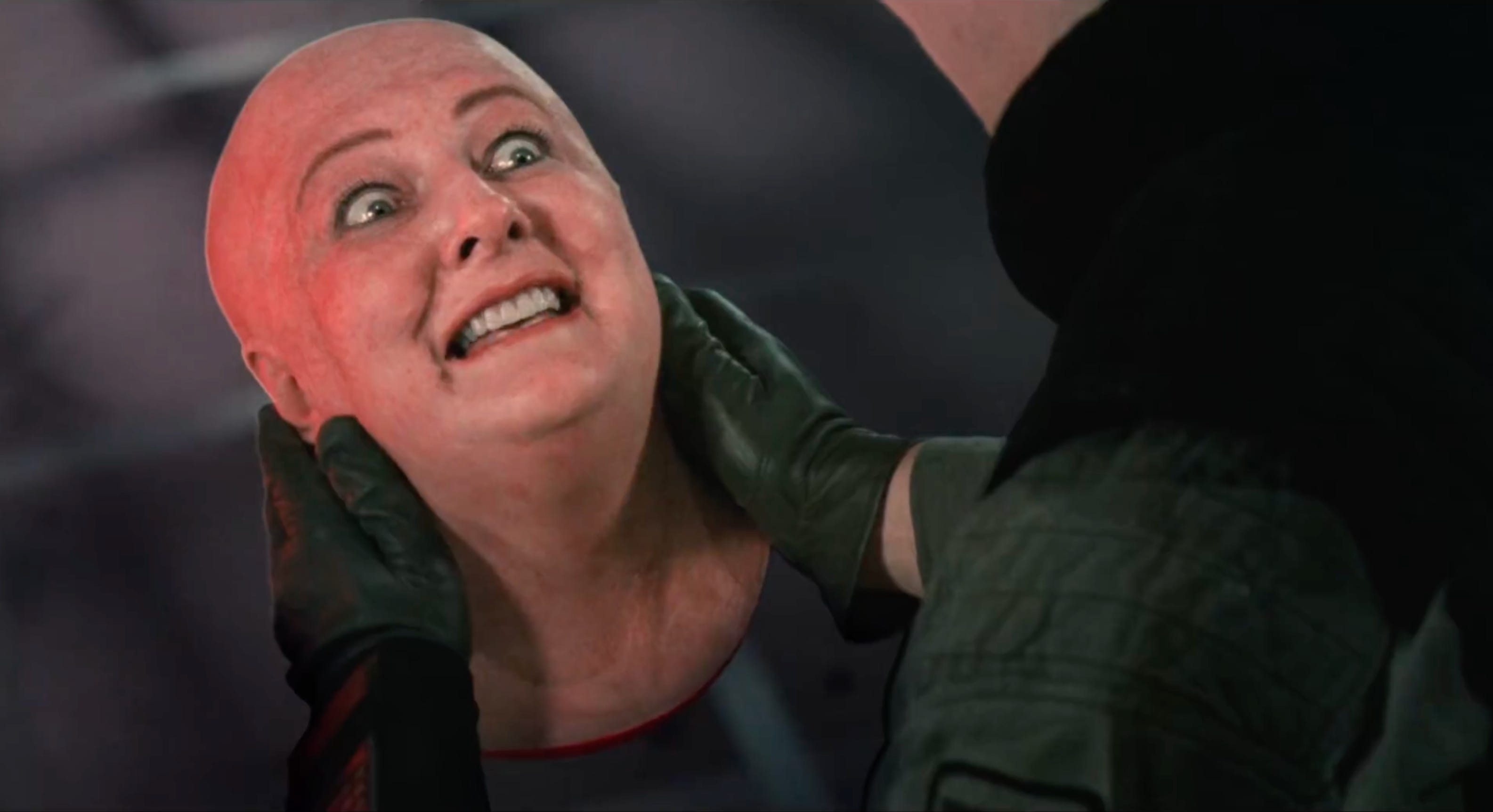
Bottin believed that his effects should fit within the logic of the scene, and that “in order for makeup to work an actor has to be able to act in it” [LA Times]. With this in mind, the search for the right actor to set up the head was extensive [CineFex].
Now, what do do with the shots around said masterpieces?
Shots of the ‘Real’ Head
Priscilla Allen gets plenty of real-face screen time before the prosthetics shots! Closeups of her manipulating her face, a crash-zoom into her shaking wildly, a front-on medium of her shaking, then a slightly side-angled shot of her still shaking . . .


All of these are broken up by shots of Richter, so it’s not so repetitive as to be boring, but she gets to demonstrate her facial elasticity, which helps sell the whole thing.
The Money Shot(s)
After a shot of the back of her head — to orient us to where she is, and how everyone is riveted on her — we get to the first effect, which is the ear-port sliding open and closed.


Then, the pièce de résistance: the head comes off in segments, then reassembles itself into a bomb.
“Originally the plan was to do it in two shots. The first would be the opening and the lifting with the fat lady head traveling up out of the shot. The second would be the head held by the mechanical hands as it closes back up. My big mistake was that I had filmed the videotape test all in one shot and Paul came back and said that was how he wanted it done in the film.”
(That’s a mechanical Arnold head in there!)
Now, if you pause and look closely, you can see a few cracks where the pieces meet, but they’re minimal.
If the next shot were to the soldiers reacting, that might make the audience think ‘of they’re covering for something!’
So instead, the next shot is a cut to a slightly wider shot of Arnold holding a completely smooth-skinned head, which helps sell the illusion.


We also compared a scene from this film to the 2012 remake,
looking at how each handled different action within the same story beat.
Reaction and Distraction!
Once the prosthetics shot is over, what does the scene do? Move on quick! Cut to reaction shots! Throw the head! Quicker cuts! BAM! Blow things up!
Why?
While the setpiece is incredible, dawdling around afterwards only invites the audience to think “Huh, does that make exact sense? Now I’m looking at the size of Arnold’s head, does it fit with the size of the segmented head? How did . . .”
Don’t let them dwell on it! Total Recall is an sci-action-adventure epic, so explode something, shoot something, run screaming; or in this case, all three.


Devil in the Details
The centerpiece ‘head shot’ is great, but it doesn’t work nearly as well in a vacuum.
A plethora of small things build the world and enhance the scene: wardrobe and props (a custom stamp for one moment); a trooper shoving a kid out of the way (01:22); billowing steam which gives depth to shots, creates atmosphere, draws our attention and/or obscures certain areas; the way background actors’ eyelines move to create dynamism and lead into cut points.


Takeaways
No matter how incredible your puppets and prosthetics are, the shots around them make a huge difference. These shots immerse the audience in the world, give many angles to properly set up Fat Lady as a character, keep us across who is where, show reactions from passerby and soldiers, and overall help sell the final money shots . . . before quickly moving the scene and story on.
Film Details & Further Reading
Total Recall (1990)
Director: Paul Verhoeven
Cinematographer: Jost Vacano
Designer: Rob Bottin
Further Reading: unless noted, details from CineFex 1990 No 44 “Ego Death” and Los Angeles Times June 6, 1990 “Rob Bottin: A Wizard in the World of Special Effects”
Next Up
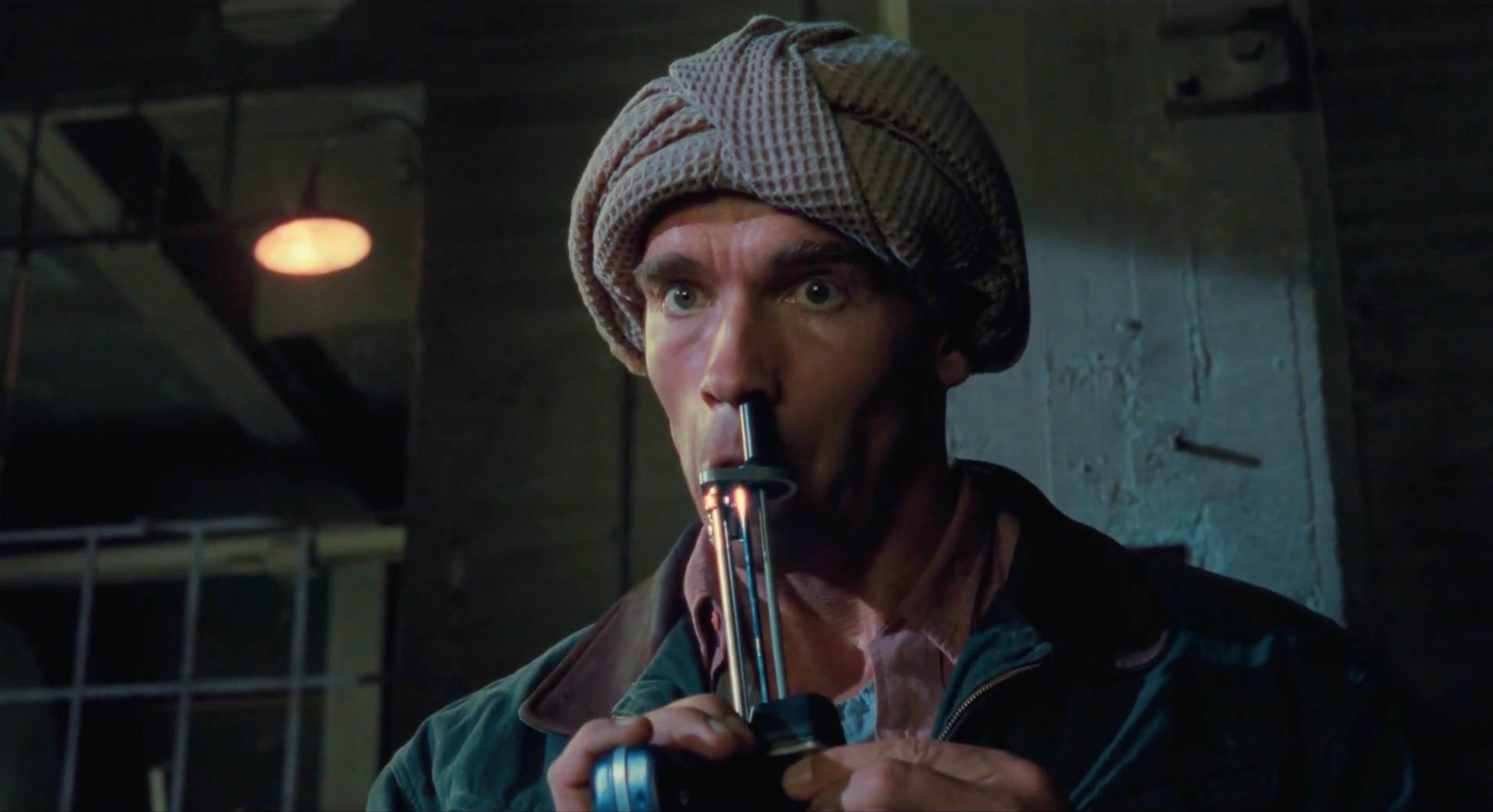
We look at Arnold doing something parents everywhere explicitly say to never do! But it’s a prosthetic nose, so it’s totally safe.
We think.
Oh loved that comparison to TR 1, TR 2 and Bourne. I actually really enjoy TR2 as well, terribly cheesy but it works for me. I loved the interior design of the apartments which I thought was very thoughtful. The world building was solid. It's hard to believe that TR 1 was THAT violent! It was very OTT.