
Memory and Mirrors: EVE'S BAYOU
how to shoot reflections on the past, in the present
Recently we looked at several symbolic, dramatic, and tricky mirror shots.
This scene from Eve’s Bayou is all those things wrapped in one.
Eve’s Bayou deals with memory, which the opening monologue calls “a selection of images, some elusive, others printed indelibly on the brain.” Several scenes use double-exposure effects, disorienting jump-cuts, or repeat shots with details slightly altered; all this underscores how memory can be deceptive and confusing, even as it shapes our lives and actions.
Then, there’s this scene.
Ebert writes, “There is a scene of pure magic as Mozelle tells Eve the story of the death of one of her husbands, who was shot by her lover; the woman and the girl stand before a mirror, regarding the scene from the past, and then Mozelle slips out of the shot and reappears in the past.”
We’re looking at ‘how’ before ‘why’ — the techniques within the shots, then what layers of meaning those shots reveal.
Technique
The scene starts with a ‘simple’ trick (nothing is truly simple when filming mirrors . . . )
As Mozelle (Debbi Morgan) starts recounting her story to Eve (Jurnee Smollett), she’s doubled with her reflection.
When her lover Hosea (Marcus Lyle Brown) walks into the scene [0:19 in video], it’s merely a matter of blocking him carefully in the background of the shot.
‘Simple.’
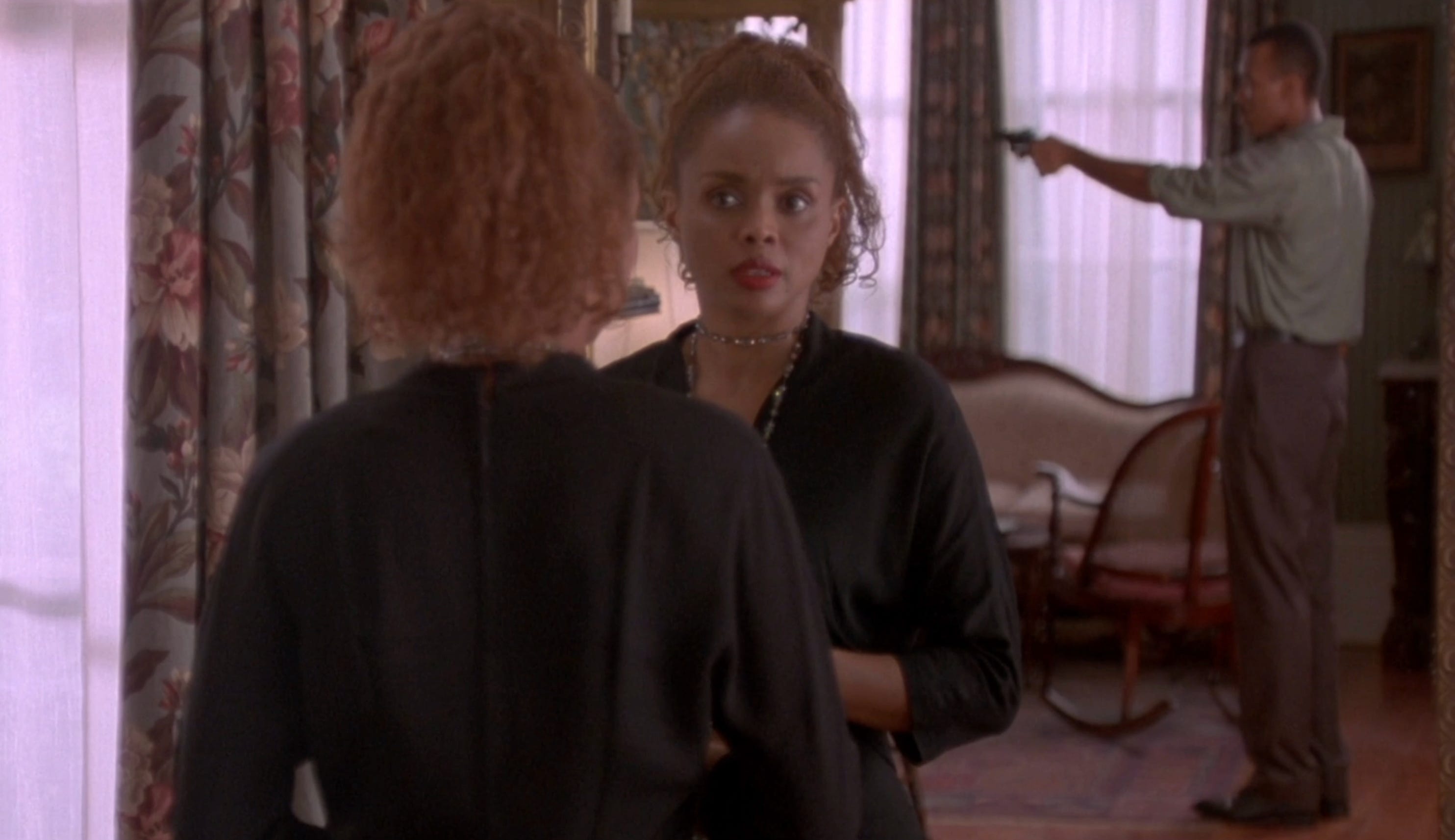
Then, as Mozelle continues to talk, her husband Maynard (Leonard Thomas) walks into the frame to join Hosea in the background.
The many curtains in the room, the angle of the mirror in relation to camera, and the spots every actor stands, would have been measured down to the centimetre to show them properly within the frame, but also to allow focus pulls.
The focus moves between Mozelle and Mozelle’s reflection, depending on where she is looking and who she is talking to.
For example, look how the focus pulls with Mozelle’s turn [1:04].
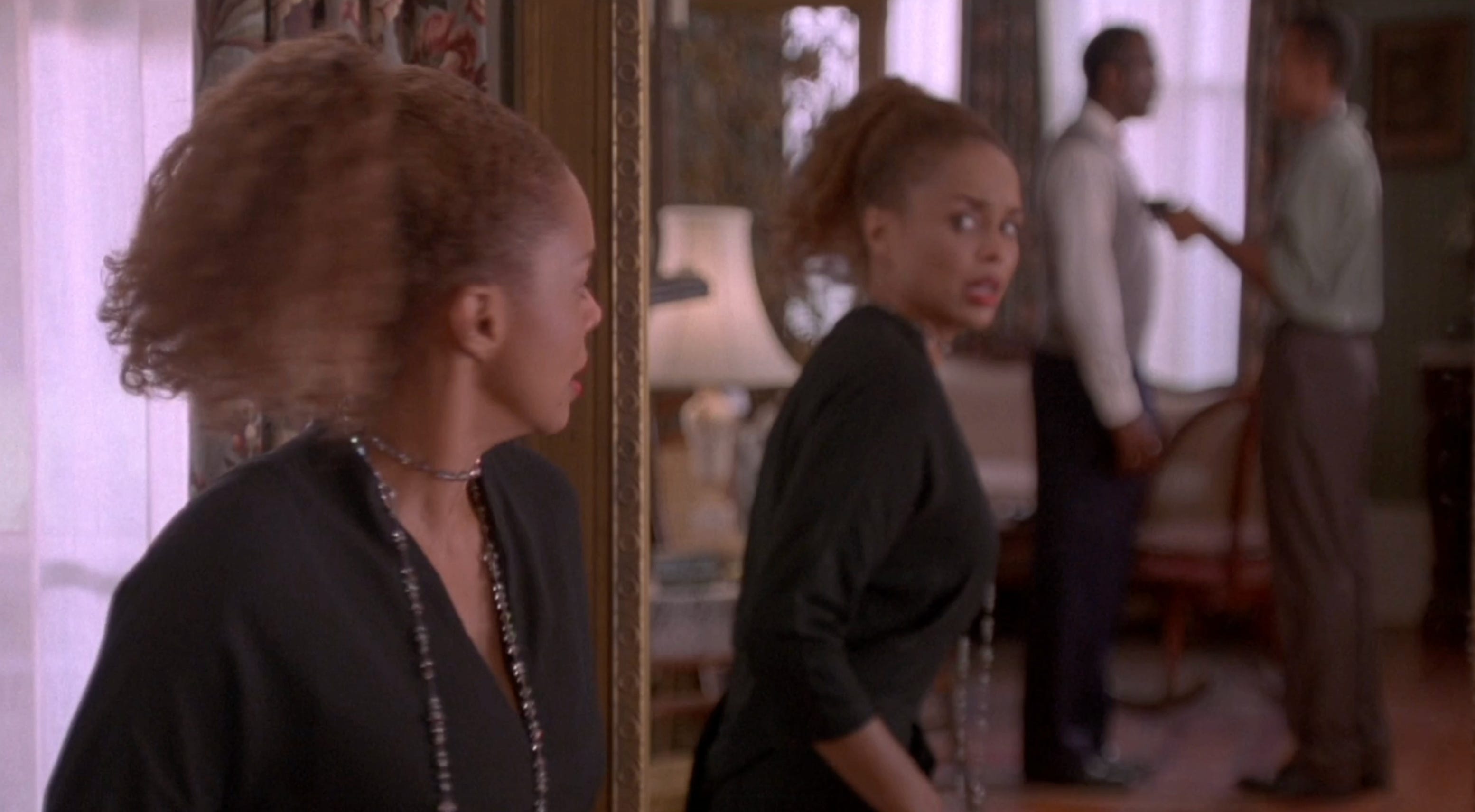
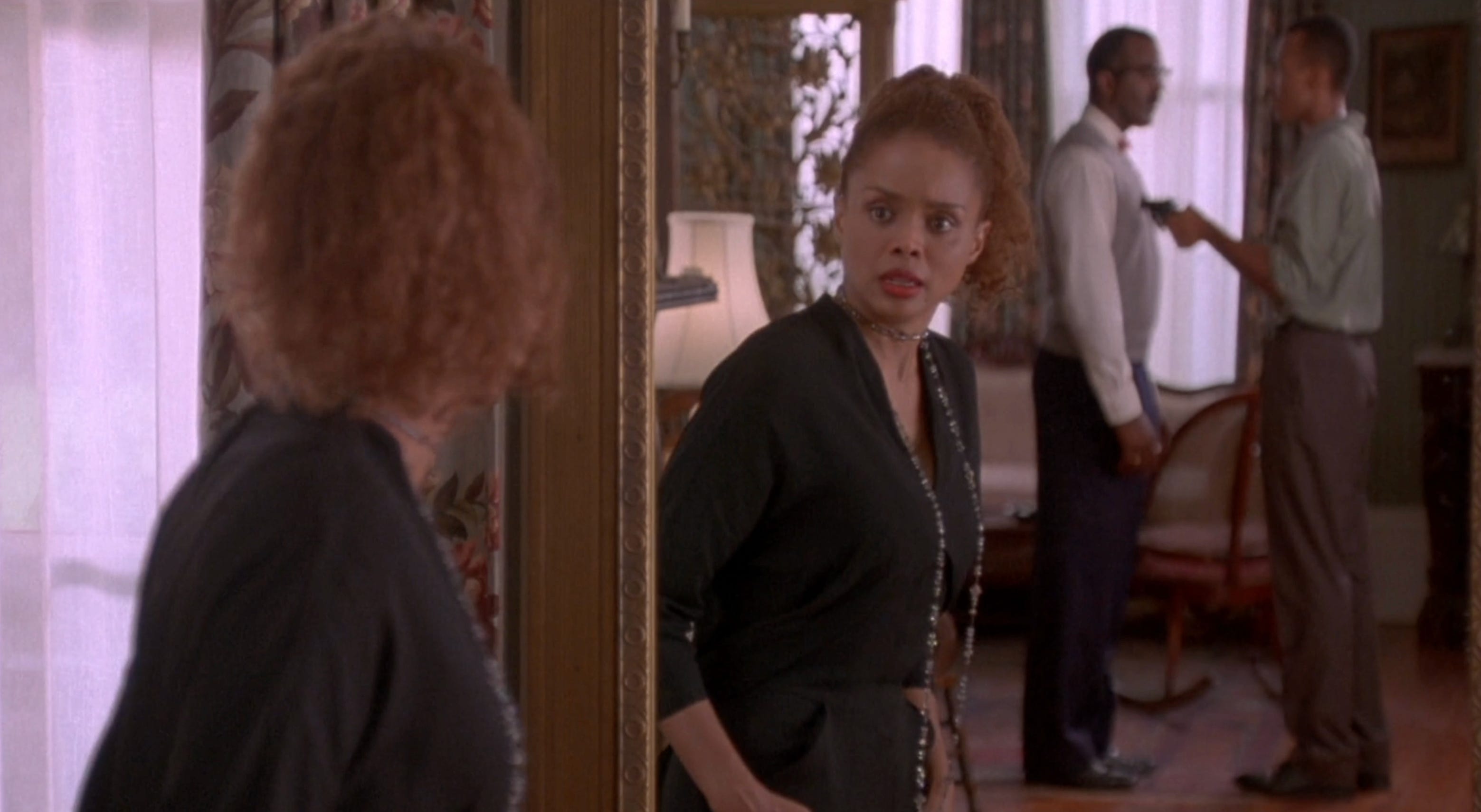
There are a few cuts, notably when Mozelle looks back at Eve and the camera shows Eve’s response. This helps the editor change between takes, especially as getting the best acting performances in the midst of technicalities such as focus pulls and hitting marks exactly is a high degree of difficulty, even when you aren’t working with children.
It also allows for moments where Mozelle is pictured without the two men behind her, without requiring them to walk in and out (which would distract from the story).


Then Mozelle walks out of frame, and reappears in the background [1:30-1:45].
So many kudos to Debbi Morgan for this performance, which would have required a very specific pace in her walk, likely avoiding equipment and wires and electrics etc. on her way from one frame to the next, getting her eyelines right when she looks back at Eve (which probably means looking at a bright piece of tape), and doing all while a camera and crew members are also moving around.
Because as she moves, the camera dollies in, in, in . . . you can see it pushing at the limits of focus; not only are the characters ‘soft’ once it reaches the end position, but you can see the detail of the curtains and wall divider are also fuzzy in the reflection.
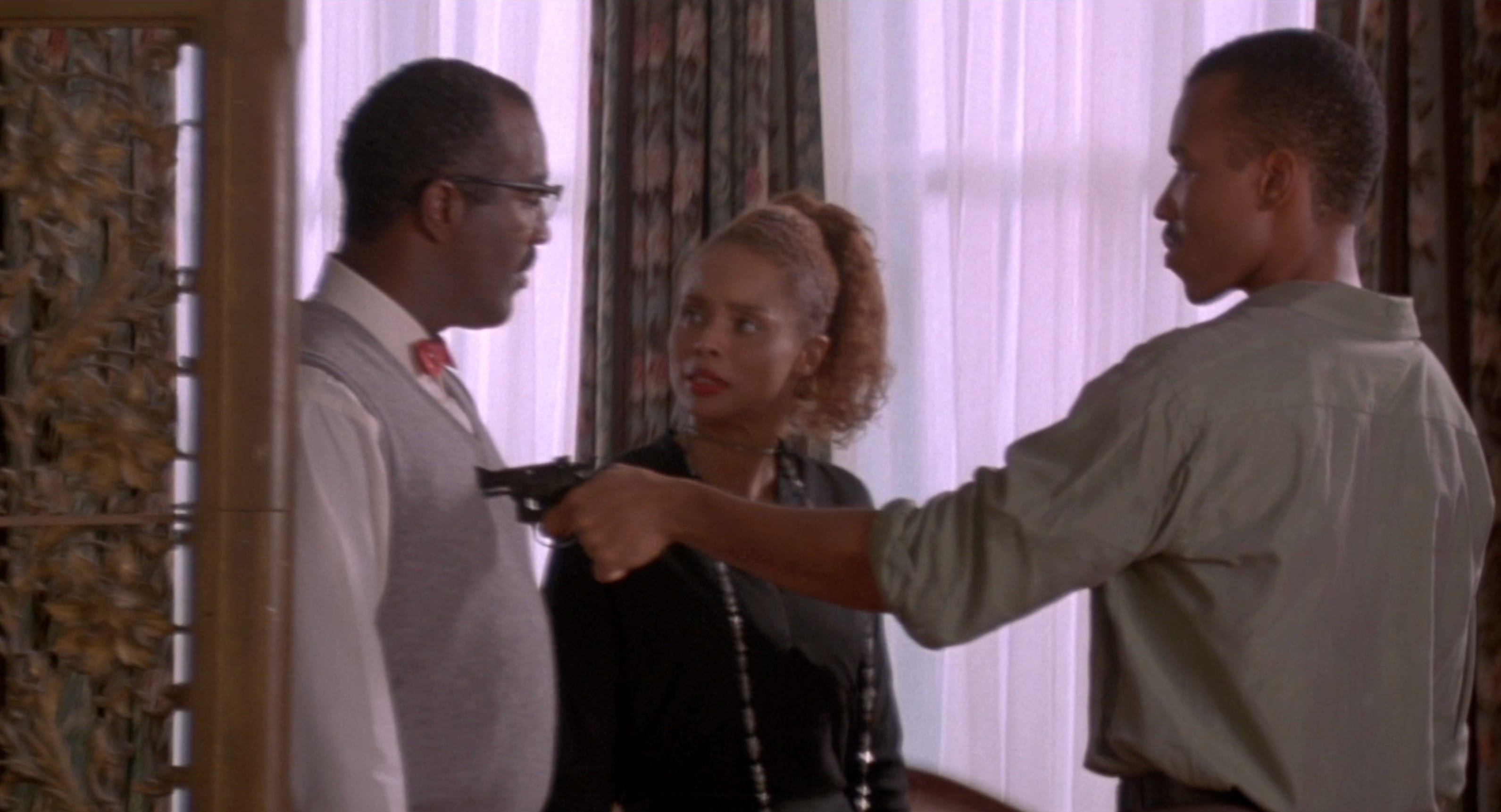
Then, to ‘get out’ there’s a cut back to Eve, who is still watching in the mirror. Her face reflected in the mirror is what’s in focus, with the three adults shown out of focus in the mirror / background.
Eve is standing exactly where Mozelle was in relation to the mirror and occupying Mozelle’s former place in the frame; this has an emotional resonance (see below), but is likely also a requirement of the blocking, as there’s very little room to work with before the mirror catches the camera and/or loses a character.
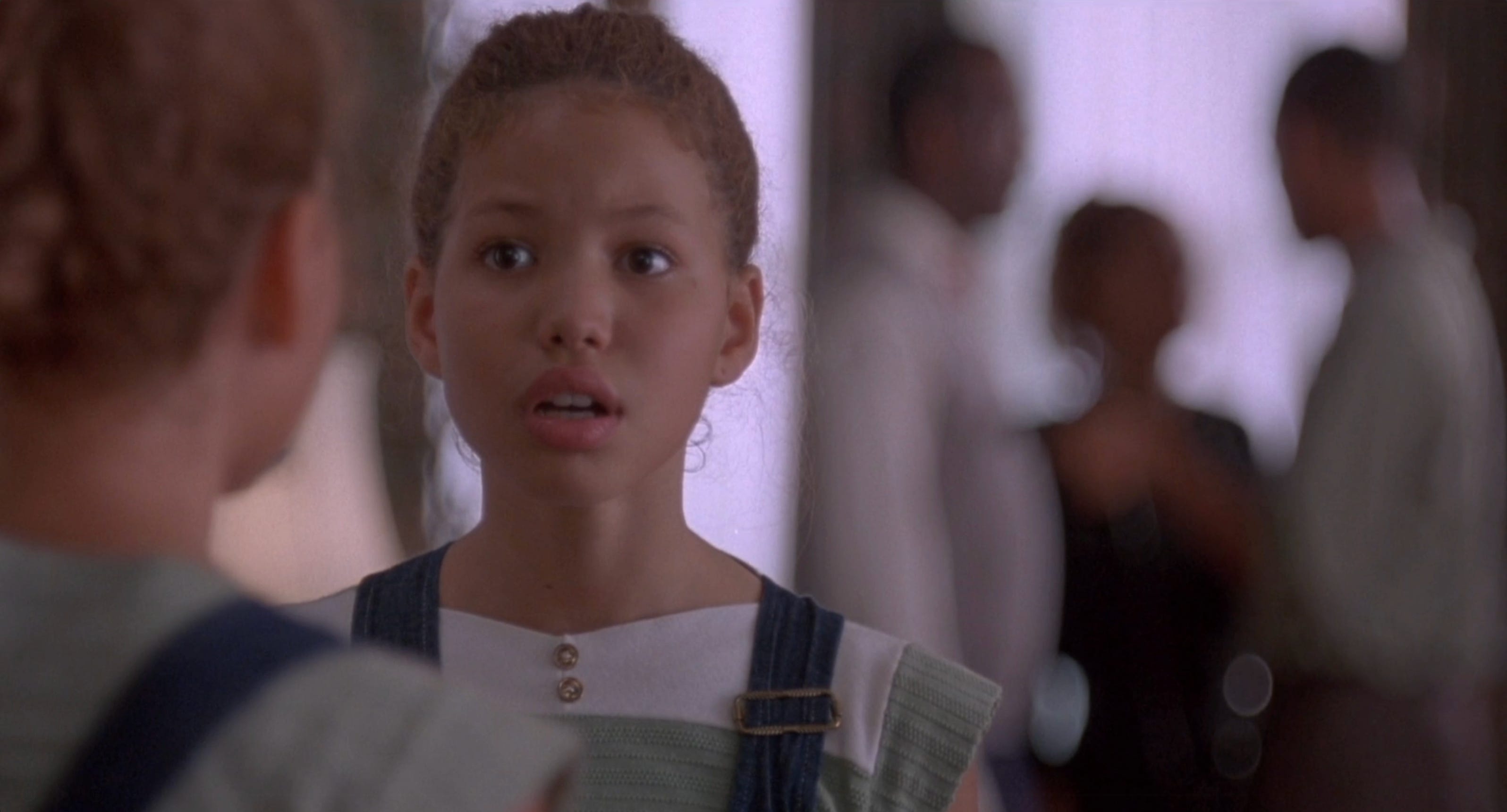
Showing the gunshot in this shot is dramatic, as is the focus pull with Eve whipping her head around [2:18-2:21], but there’s also a practical reason.
Trying to do the timing of a prop gun discharge and potentially a squib [fake blood packet] within the long take of that mirror closeup, with all the other choreography which comes before, would be risky: a half-second of timing off, a squib which doesn’t burst exactly right, an actor missing a cue, would look too obviously fake, and require an entire reset, and also a lot of extra time if they did use a squib; a new squib needs to be set, the actor needs a new shirt, etc. etc.
The technique of showing it out-of-focus through Eve’s point of view avoids all these potential pitfalls.
Meaning
There’s so much going on here we could write five posts on it (and we’re not even touching on the sound mixing, which also brings in voices drifting from the past in key moments!), but we’ll look at all the really big thematic meanings.
When Hosea first points the gun at Maynard, Maynard is out of frame, so it looks as though Hosea is pointing it at Mozelle’s head . . . which is how she feels about the situation.
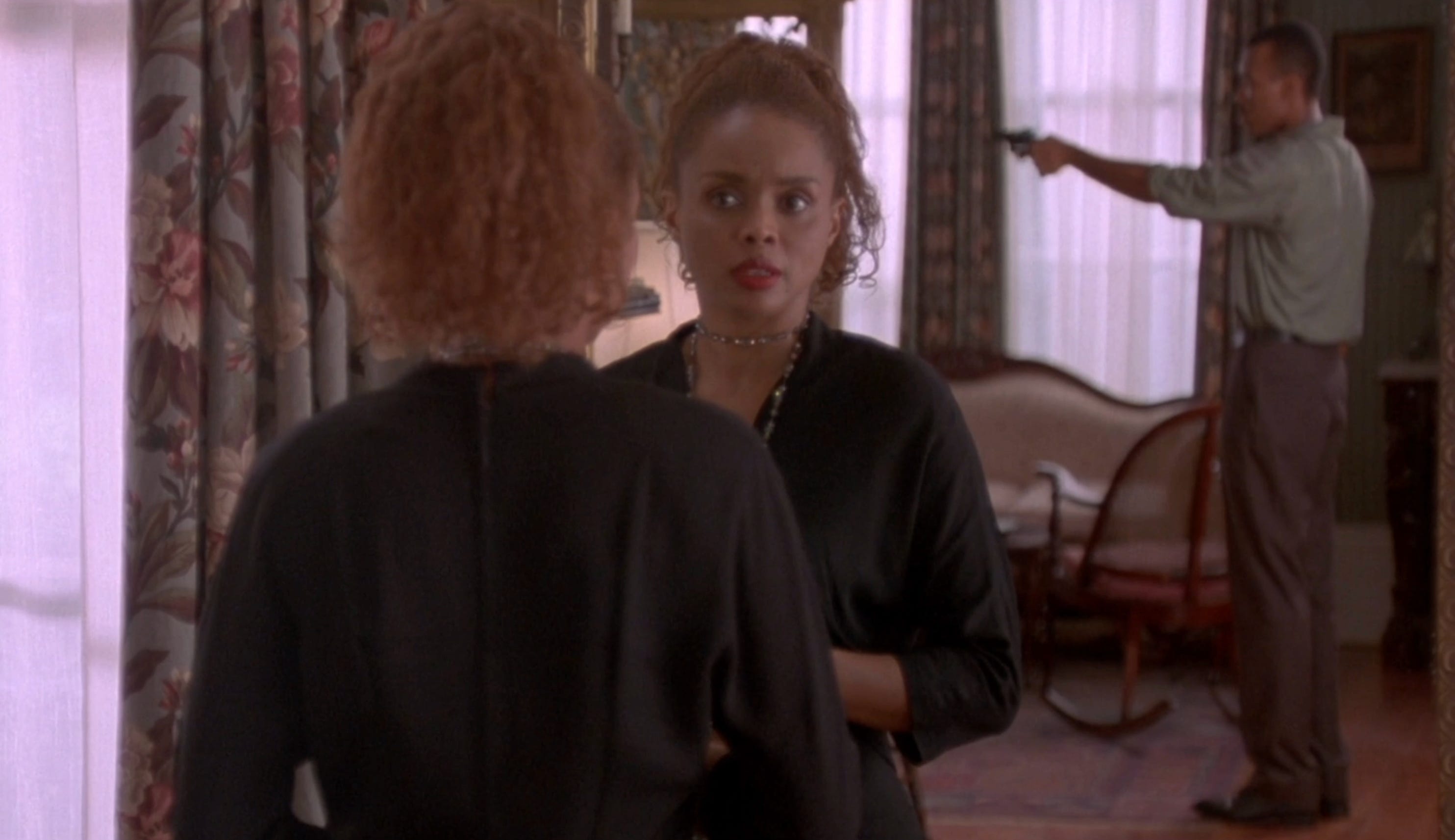
We’ve already seen how Mozelle is gifted — and sometimes feels cursed — with second sight.
As she recounts her story, first she’s ‘doubled’ while her lover and husband are only in frame once each. Hosea and Maynard are stuck in the past, while at the start of her story Mozelle is reliving the past while stuck in the present.
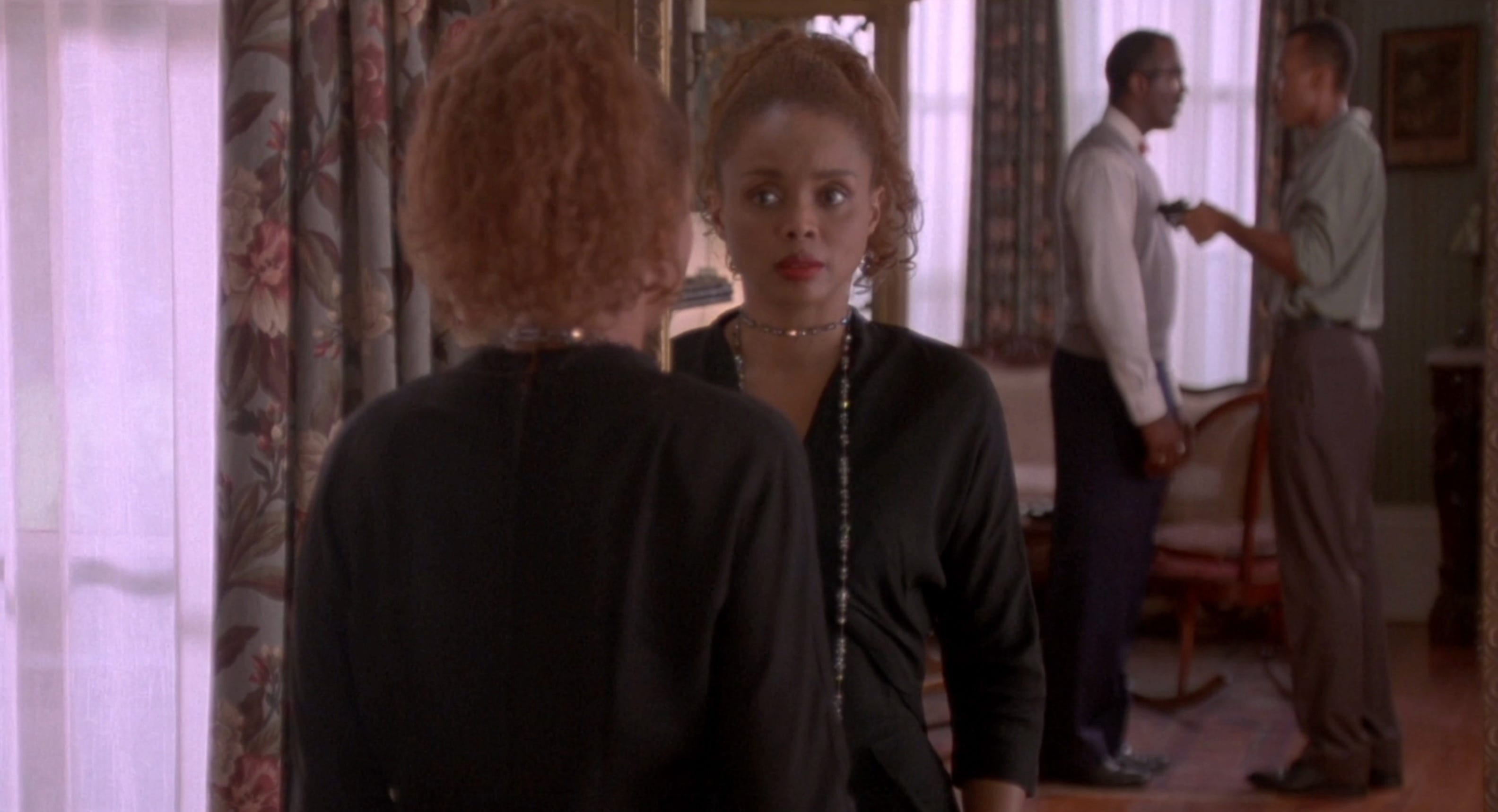
At first, Eve is still in the foreground, watching, she has taken Mozelle’s place as living in the present while seeing the past. (We will learn Eve also has Mozelle’s gift of sight, so putting them in the exact same place in frame is intentional . . . though also likely a technical necessity, as mentioned above.)
When Mozelle walks backwards, she, too, appears in the frame only once, same as Hosea and Maynard; she has now lost herself in memory, and is living in the past.
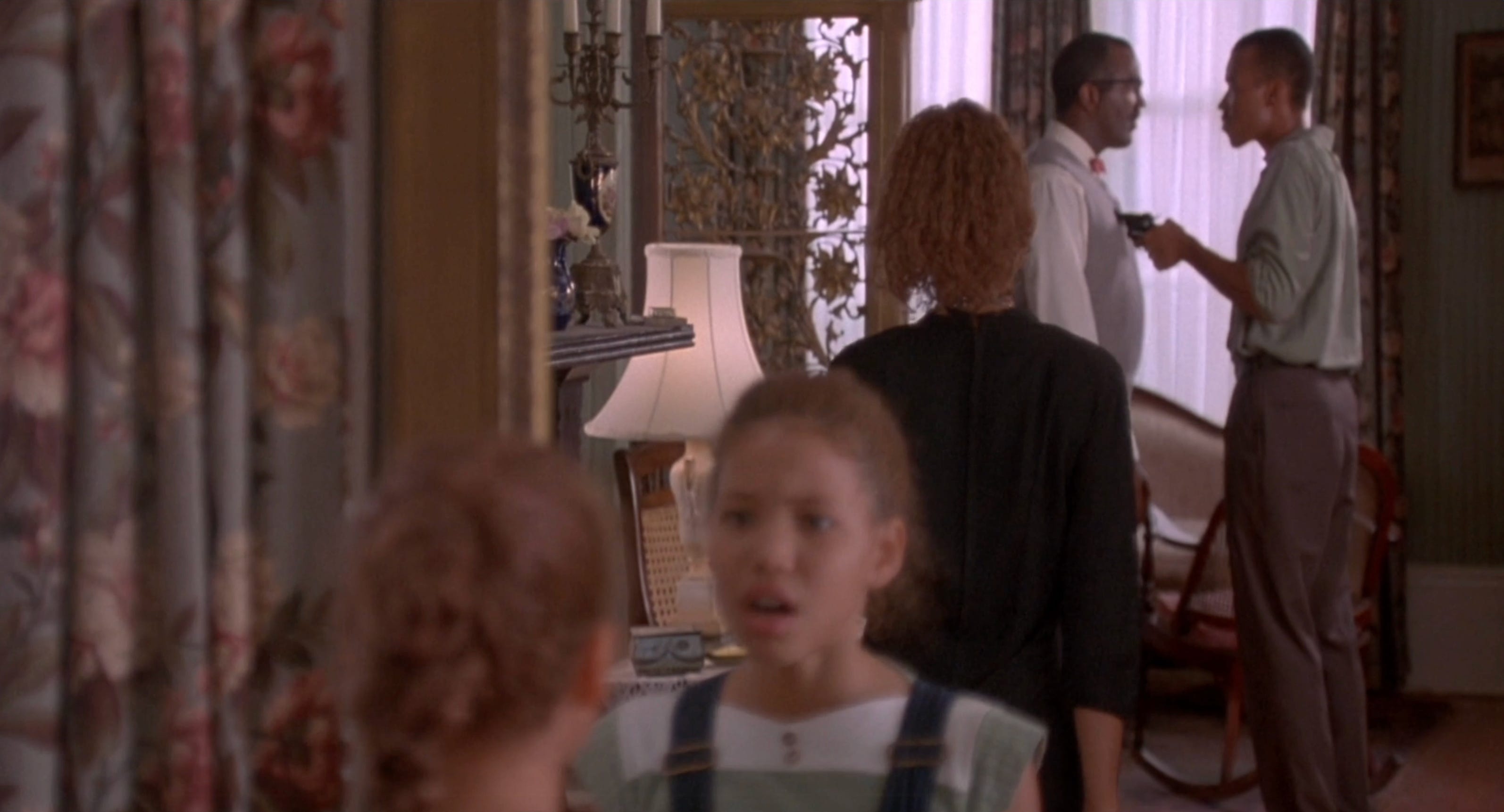
As the camera dollies in to put us ‘in’ Mozelle’s history, the scene continues to play out until we find ourselves fully in the story, in the past, in memory.
The softness of the focus only adds to the hazy feel of memories of time long gone, and the overall magic of the scene.
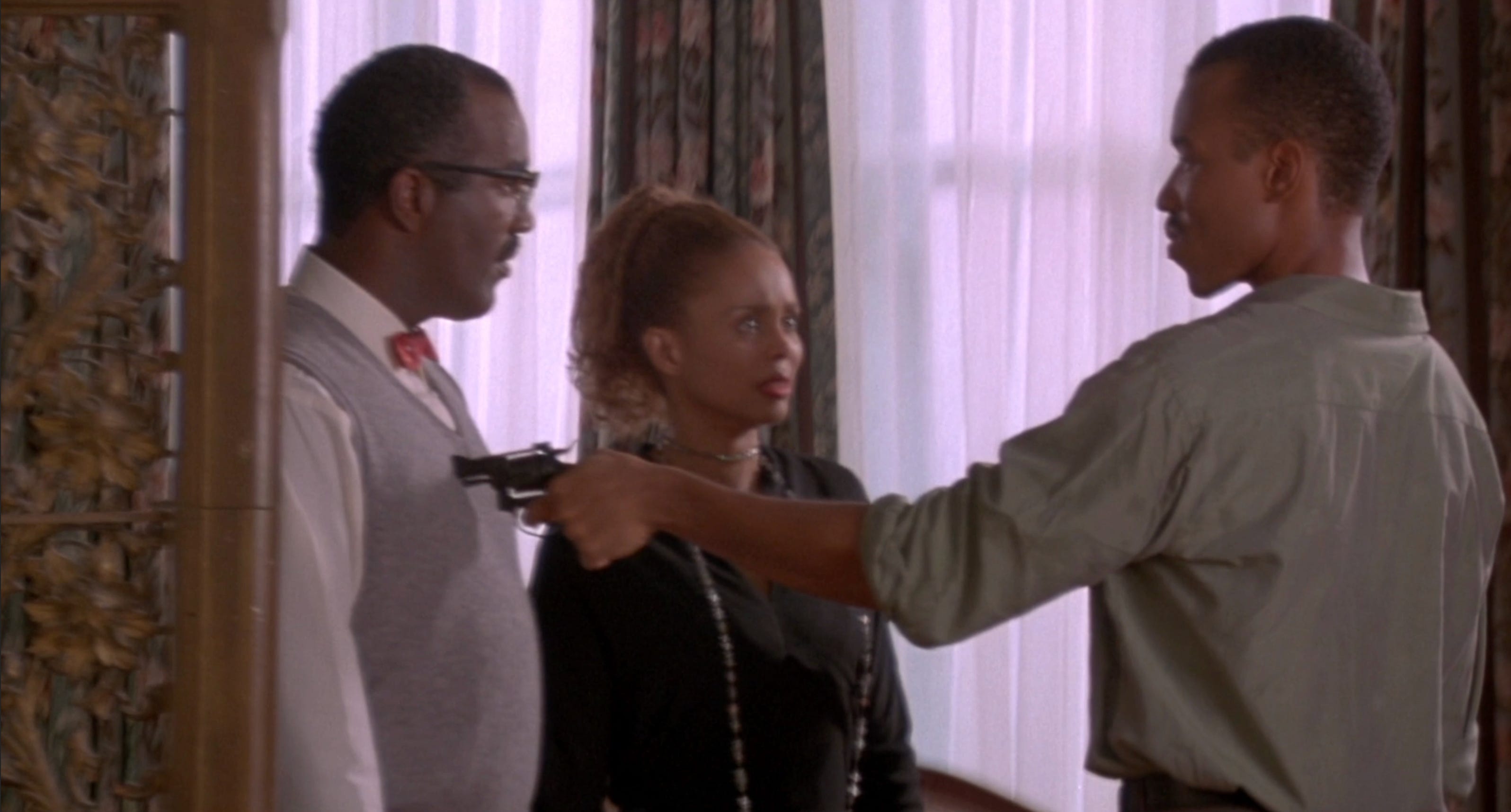
And yes, the ‘climactic moment’ of Mozelle’s story is seen in Eve’s point of view, but the whole film is Eve’s story, so this is thematically fitting.
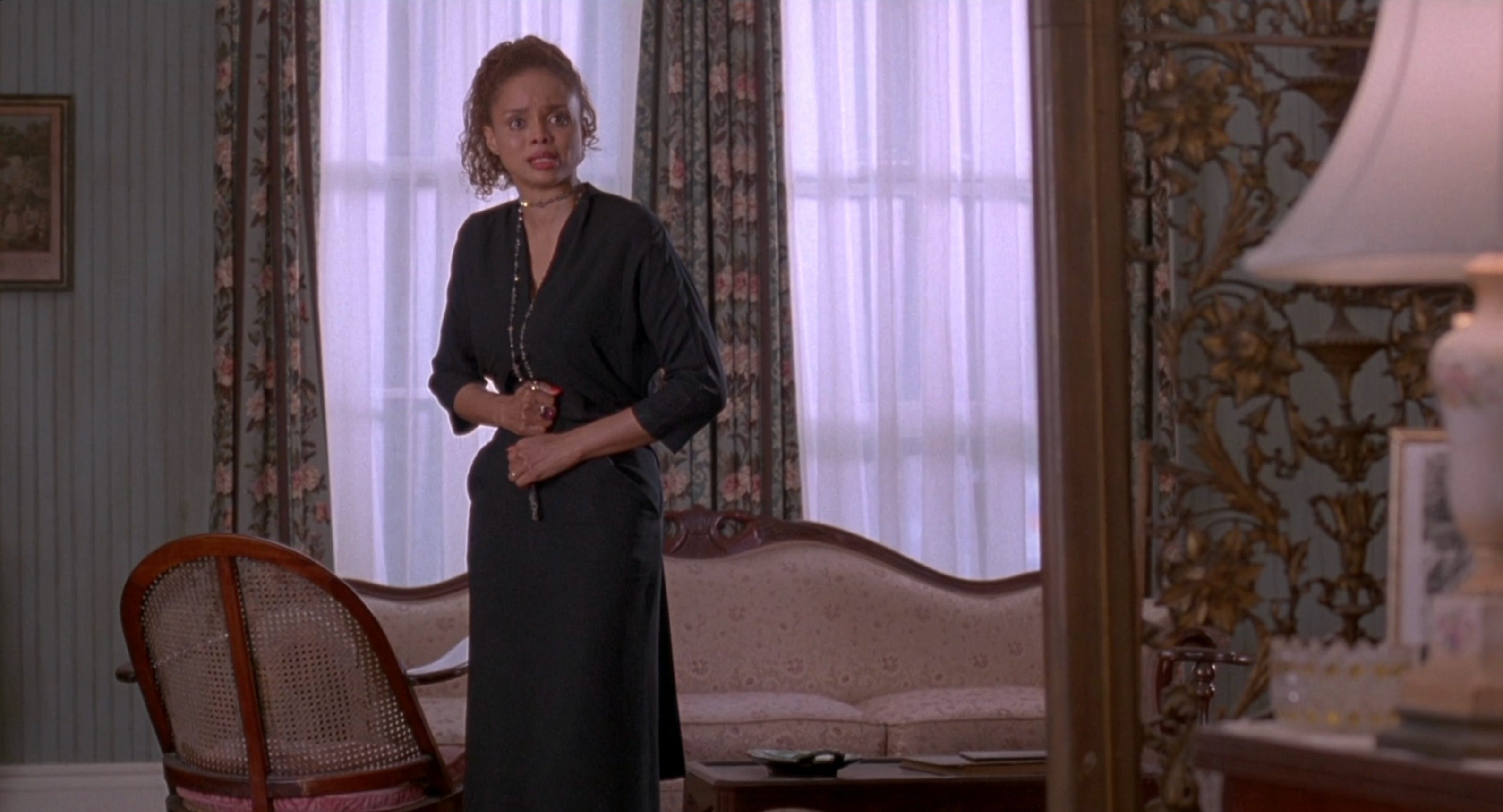
Then, after the gunshot startles Eve into turning around, the scene ends with Mozelle standing — not in a reflection, not with her husband and lover, but alone where she had been reminiscing once she walked ‘into her past.’
Takeaways
There’s no way to guess at exactly what came first; figuring out the shots and what could work technically, versus figuring out what director Kasi Lemmons wanted to show in a reflection, when she wanted to see Mozelle doubled versus showing Eve, etc., to get to the emotional core of the story. Likely they both evolved together.
The takeaway is, if you have a good idea what you want to convey, you can keep that in mind while working through the techniques, testing angles and focus etc., and make theme and technique work together.
And sometimes, like Eve’s Bayou, you end up with a scene of pure magic.