
Cracked Reflections: THE APARTMENT
Last week we looked at many different ways to shoot in mirrors — most of which reveal how characters feel.
Today, we look at how The Apartment uses mirrors two different ways; they still show how characters feel, but they’re also used to convey plot.
CW: this post frankly discusses a character’s suicidal ideation;
no harmful actions are discussed or shown
A small compact mirror leads to discovery of a love affair; a large shaving mirror displays a character’s thought process about suicide; finally, we look at the practicalities of shooting those bright mirror glints!
Discovering an Affair
When Baxter (Jack Lemmon) gives his boss Sheldrake (Fred MacMurray) a compact mirror to return to a woman Sheldrake was sleeping with at Baxters’s apartment, Baxter doesn’t know to whom the mirror belongs, but he does warn Sheldrake the mirror is cracked.
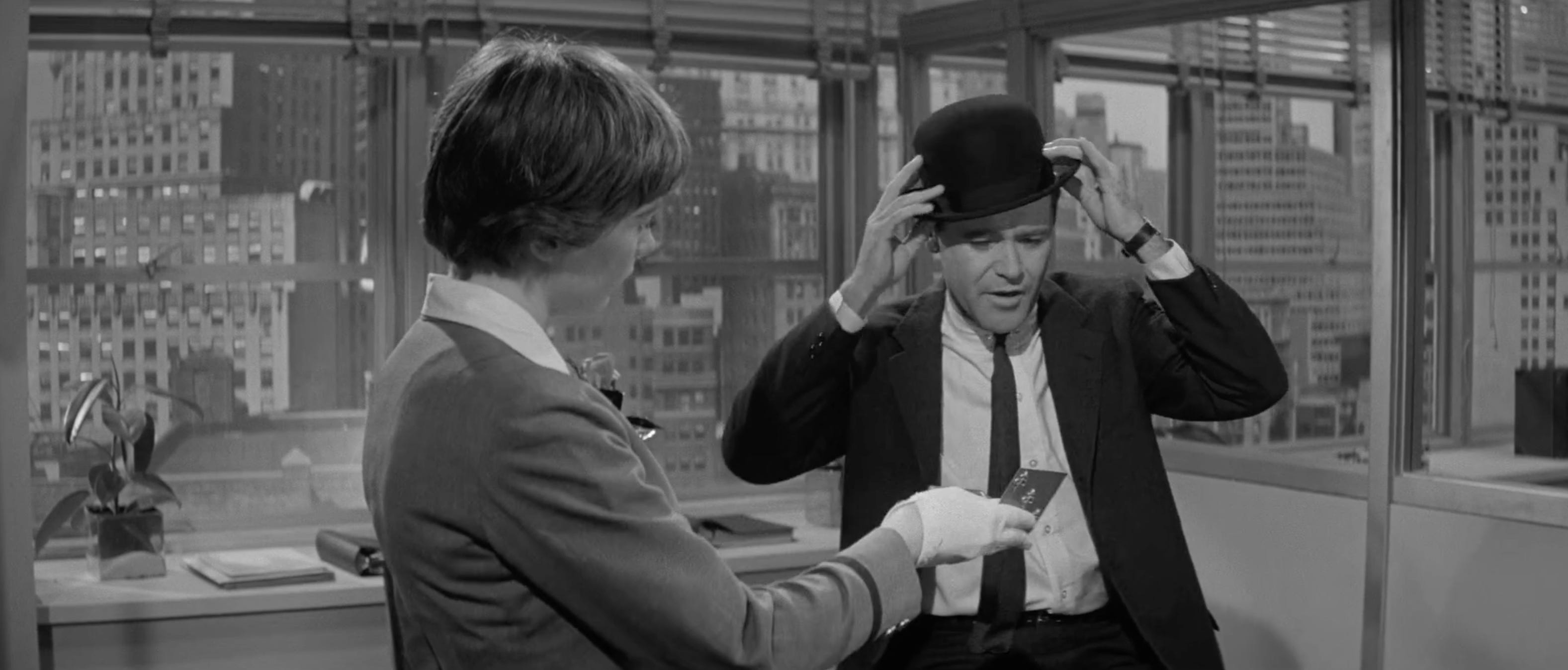
Five minutes of screentime (and a few days of ‘real’ time) later, Baxter tries on a hat for Fran (Shirley MacLaine)
When Fran offers Baxter her mirror so he can check how the hat looks, he (and we) see that same cracked glass.
This is how Baxter discovers Sheldrake has been sleeping with Fran . . . who just so happens to be the woman Baxter wants to ask out.
As for that square reflection on Baxter’s face, we talk about getting it just right, below.
Contemplating Suicide
A while after this discovery, Sheldrake breaks up with Fran, then leaves alone in Baxter’s apartment. Fran goes into the bathroom to wash her tears away.
Baxter’s shaving mirror has been established in Baxter’s daily preparations before, but it’s also clearly noticeable in the frame here from the start.
The camera moves closer as Fran comes in and washes her face, then as she dries her face with a towel — the motion which brings our attention more fully to her face — we see her eyes fixate on the mirror, before the scene cuta to an insert shot, showing what Fran is looking at.


This insert shot is more directly of the mirror, highlighting the pill bottle out of the many bottles and clutter of the medicine cabinet.
Then Fran brings the pill bottle into frame.
This is a cool shot of itself, but it also puts us directly “in her shoes” or point-of-view, letting us consider what she’s thinking about while we can also read the label up close.
Both Baxter’s mirror and his sleeping tablets were established earlier, but this scene makes great use of the mirror to lead Fran to discovering them, then to guide us along with Fran’s train of thought.
Finally, within the same angle as the establishing shot (from 0:30 in the full video), the camera moves again, showing Fran’s actions, which tell us she’s made up her mind.
Getting the Glint
Look closely at the shot where Baxter looks in Fran’s mirror, and you can see the glint is entirely ‘faked.
When Baxter looks in the mirror, the bright ‘reflection’ square on his face is actually a light shining at him. The angle of the light is pretty good, but the giveaway is when he snaps the mirror shut.
When whomever is operating the light turns it off a split second after Jack Lemmon closes the mirror, the reflection fades all at once instead of getting ‘cut off’ by the compact lid closing. It also takes a moment to fade, as the bulb goes down more gradually than a mirror snaps closed.
Takeaways
The Apartment does use voiceover and dialogue, to detail plot points and feelings. But shots are another tool which can reveal story and emotions!
Using a mirror to show Baxter discovering the plot point of Fran sleeping with Sheldrake, then another mirror to outline Fran’s ideation without having her say anything, is aesthetically beautiful and — in the case of the cracked mirror showing Sheldrake and later Baxter — beautifully symbolic . . . even if they can be tricky to actually shoot.