
Week 26.12 - SHADOW PLAY Socials Roundup
16 Mar - 22 Mar 2026: whether made by puppets or people or panthers, shadows can be very effective!
Week 26.12 posts include shots from Cat People (1942); Legends of Tomorrow (2016-2022); He Got Game (1998); Deadline at Dawn (1946); and Bad Lieutenant: Port of Call New Orleans (2009).
We also looked at several uses of shadow in Quai des Orfevres.
He Got Game
Just a stunning shot from Spike Lee in the opening sequence of his basketball drama.
Cat People
This wonderful shot starts on the shadow of a canary bouncing between the paws and mouth of a painted panther, before showing us the canary in context of the room and Irena, who is (unbeknownst to her) at the beginning of her transformation into the titular Cat Person (making this quite-literal foreshadowing).
check out how Cat People uses editing and sound effects
to create an iconic jump scare
and
how Caged uses stark shadows to make people look like monsters
Legends of Tomorrow
We’ve talked about many of the ways this CW show does big gags on the cheap and finds creative workarounds for alien attacks . . . here’s them using shadows to do an alien eating a human, from episode 7.11 “Rage Against The Machines.”
The immediate follow-up goo stunt is reminiscent of another small Canadian show making good use of budget . . . this shot from Wynonna Earp.
Deadline at Dawn
This scene has lots of shadows for the fun of it - check out how the bottle and glass next to that apartment door on the lower right are placed to refract light!
It all pays off when Alex and June step from darkness into light, and stare into the bright-white, dead face of Edna staring back.
Bad Lieutenant: Port of Call New Orleans
Bad Lieutenant uses incredibly particular lighting and blocking to get shadows to fall just right in this scene.
First we see McDonagh (Cage) in a shadowy storage room from the approximate POV of the door.
Cut to a closeup of the door, where the light is carefully calibrated to enable Mundt (Michael Shannon) to transition between faceless shadowy shape, to muddled expression, then back to shadow.
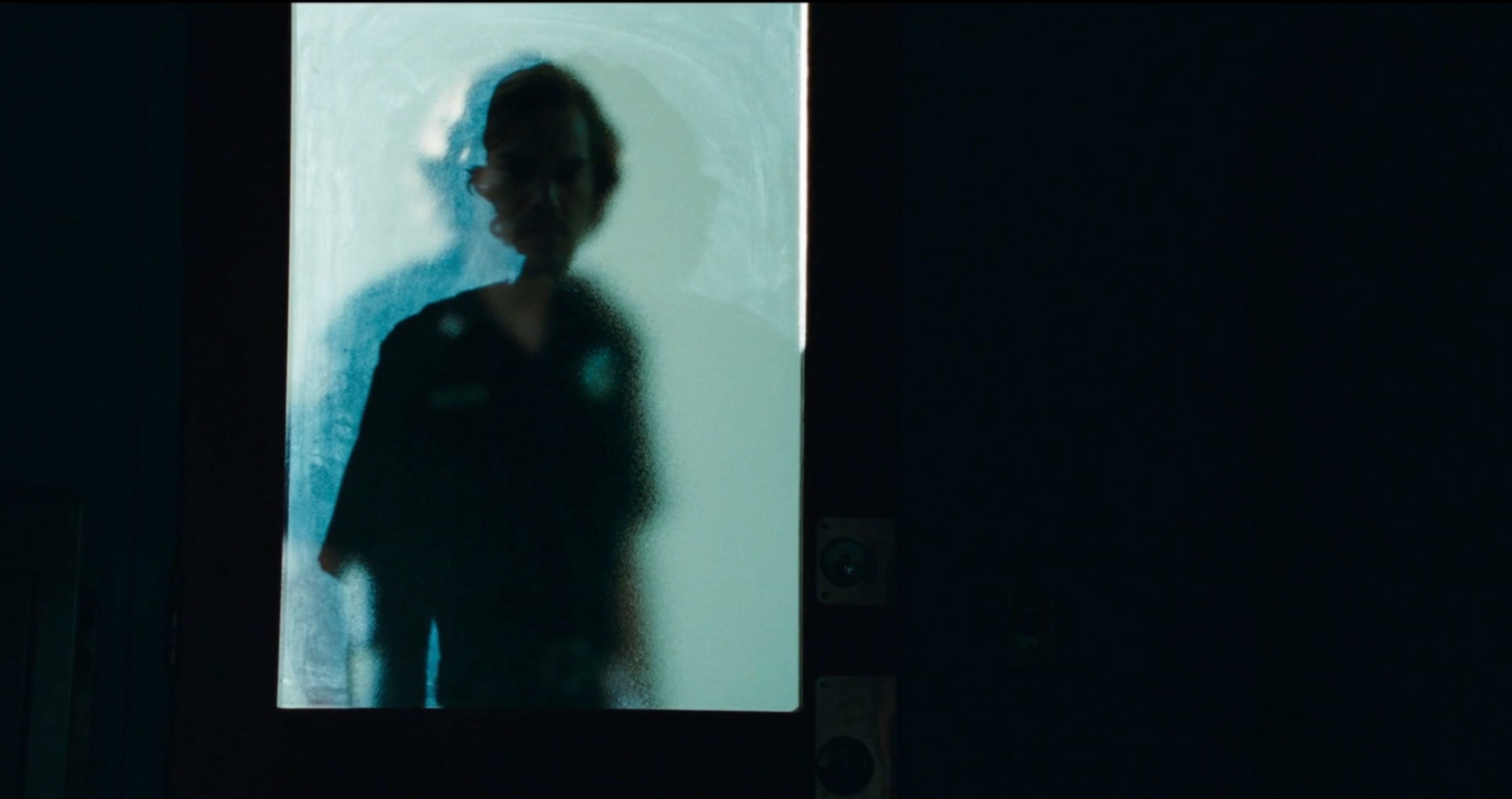
Next is a low angle which keeps the ‘light block’ of the door within frame; even as Mundt steps in darkness obscures his face while lighting McDonagh’s. Because of the shadows, we can’t read Mundt’s expression, only his body language. The lighting locks us on on McDonagh’s response, before he sits up, the camera cuts to a new medium angle.
Even in the new angle McDonagh leans between light and dark. This play of light and dark is atmospheric, thematic, and keeps us the audience straining to ‘read’ the men’s expressions.